
Snags
How to write a snag list: spots a carpenter can find
How to write a snag list a carpenter can follow: name the room, item, exact place and gap, then add a photo in context and a close-up.
A good snag names four things: the room, the item, the exact place on it and a measurement, for example master bedroom, wardrobe, right end, 6–8 mm gap to the wall. Give it a short title, one photo in context and one close-up, one person in the studio to chase it, and a due date.
Every studio has heard some version of it at handover. The client says the wardrobe gap was never fixed. The supervisor says it was. Nobody can settle it, because the snag list only ever said “wardrobe issue”.
This guide shows how to write a snag list where every line can be found, fixed and checked by someone who wasn’t there when it was raised. It comes from the team behind DoYourDesign, studio management software for interior design studios, but the practice works just as well in a notebook.
Why vague snags come back as disputes
A snag is a small promise: this is wrong, and we will put it right. A vague snag can’t be held to that promise.
“Wardrobe issue” could mean a gap at the wall, a chipped edge, a shutter that won’t close or a handle out of line. The carpenter fixes one of them. The client meant another. The list now says it’s done, and the argument starts.
Every line on a snag list should answer three questions without anyone needing to ask: where is it, what is wrong, and how will we know it’s fixed.
What makes a good snag spot
The spot answers “where”. Write it so precisely that someone who has never been inside the flat walks straight to it. Build it from the largest part to the smallest:
- Room: master bedroom
- Item: wardrobe
- Exact place on the item: right end
- Measurement or mark: 6–8 mm gap to the wall
Together: master bedroom, wardrobe, right end, 6–8 mm gap to the wall.
| Vague | Findable |
|---|---|
| Wardrobe issue | Master bedroom, wardrobe, right end, 6–8 mm gap to the wall |
| Tile problem in kitchen | Kitchen, under the window, second tile from the left, chipped corner |
| Paint touch-up | Living room, wall behind the TV unit, about 1.2 m from the floor, roller mark |
| Electrical point | Kitchen, hob wall, third socket from the left, cover plate not flush |
A few habits keep spots consistent across a whole handover:
- Use the drawing’s room names. If the drawings say “Bedroom 2”, don’t write “kids’ room”.
- Fix left and right. Describe them as you face the item from inside the room.
- Measure, don’t guess. A tape reading of 6–8 mm settles more than “small gap”.
- Name the property when there is more than one. Two flats in the same tower, or two office floors, need saying.
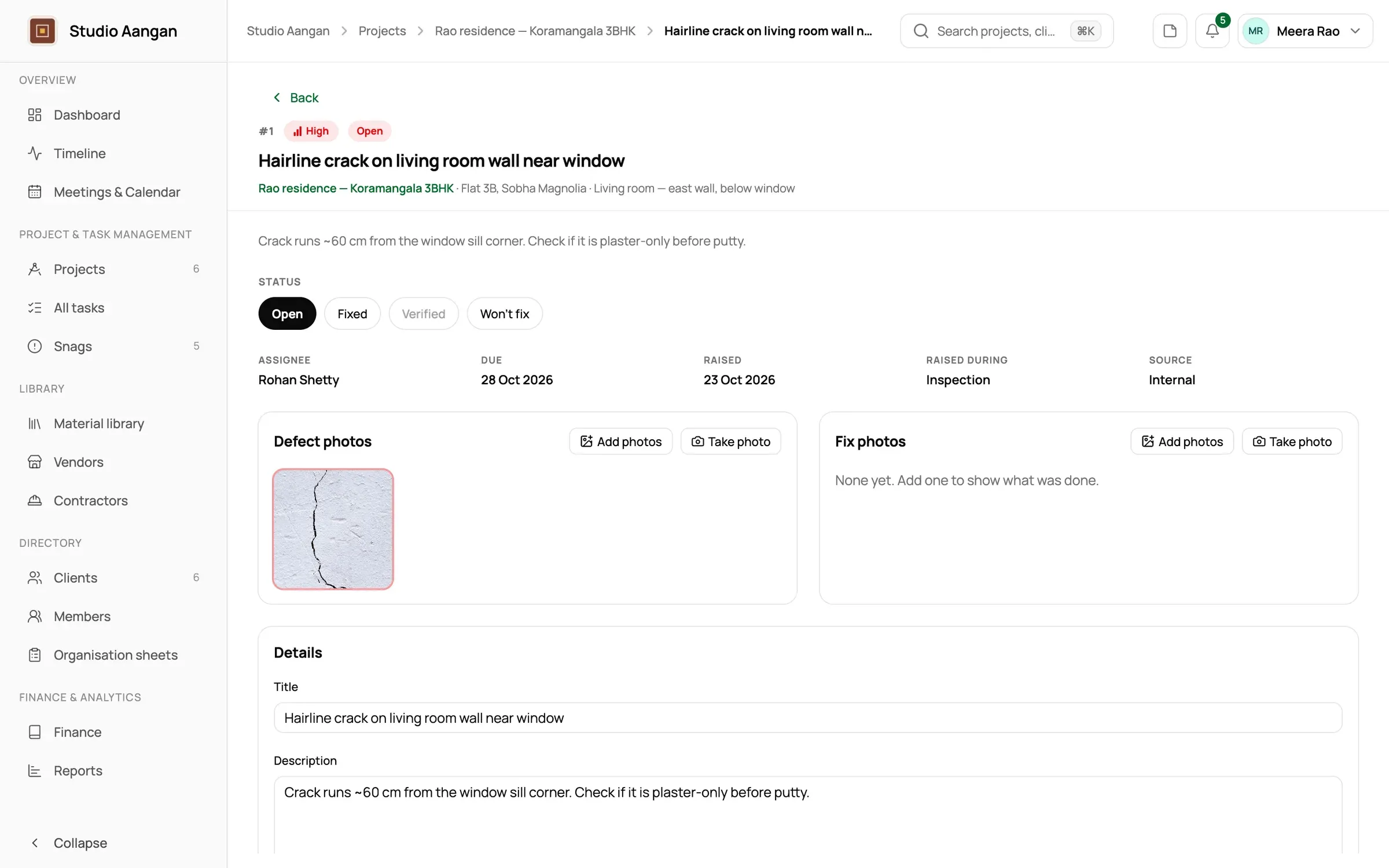
Sheet A-102: a snag whose spot anyone can find.
Title vs description: give each one job
The title, description and spot each answer a different question. Keep them apart, so nothing important is buried in a paragraph.
- Title says what’s wrong in a few words: Wardrobe gap at the wall. It has to read well in a list of forty.
- Description says what’s wrong in a sentence, then what fixed looks like: Gap between the side panel and the wall. Close with a scribed filler in matching laminate, no visible gap.
- Spot says where, and only where.
Writing what fixed looks like is the step most snag lists skip. It’s also what lets someone else check the work later.
Two photos: one in context, one close up
A close-up shows the defect but rarely where it is. A chipped laminate edge looks the same on every shutter in the flat.
So take two photos for every snag. Stand back for the first, with the room and the item in frame. Then move in for the close-up of the defect itself. The context photo helps the carpenter find it, and shows the client exactly which defect was raised.
When the work is done, take fix photos from the same two angles. Before and after then compare like for like.
One person to chase it, and a date
Every snag needs one owner inside the studio, usually the site supervisor or the designer on the project. The carpenter does the work. Your person makes sure it gets done, photographed and closed.
Give it a due date too. Without one, “next visit” quietly becomes never.
Record severity as a fact about the defect (low, medium or high), not as how loudly the client asked. And don’t let the person who fixed it be the one who signs it off.
A snagging checklist for every line
Use this snagging checklist for each snag you raise on a handover walkthrough:
- A short title saying what’s wrong
- The property it’s in, if the project has more than one
- A spot: room, item, exact place, measurement
- A description that includes what fixed looks like
- Severity: low, medium or high
- Who found it: the studio or the client
- One owner in the studio
- A due date
- Two photos: one in context, one close up
For closing the list once it’s written, read A snag list that actually closes.
Frequently asked questions
How do you write a snag list?
For each defect, write a short title, the property it’s in, a spot naming the room, item, exact place and measurement, and a description of what fixed looks like. Add severity, one owner in the studio, a due date, and two photos: one in context, one close up.
Should a snag be assigned to the carpenter?
Assign it to someone in the studio, such as the site supervisor, who chases it to closure. The carpenter does the work. The studio’s assignee is accountable for getting it done, photographed and closed.
In DoYourDesign, each snag gets a snag number within its project (#1, #2…), a Location and a free-text spot, so you write the room, item, exact place and measurement just as above. It carries a severity (Low, Medium or High), a source (Internal or Client), an assignee who is always a project team member and never a contractor, and a due date, after which an unclosed snag shows as Overdue. Defect photos and fix photos sit on the snag, and they freeze once it is Verified or marked Won’t fix. To see a handover snag list on projects like yours, book a walkthrough or write to [email protected].